

How to Design AI Automation Workflows
A CXO guide to moving from AI experiments to real operational impact.
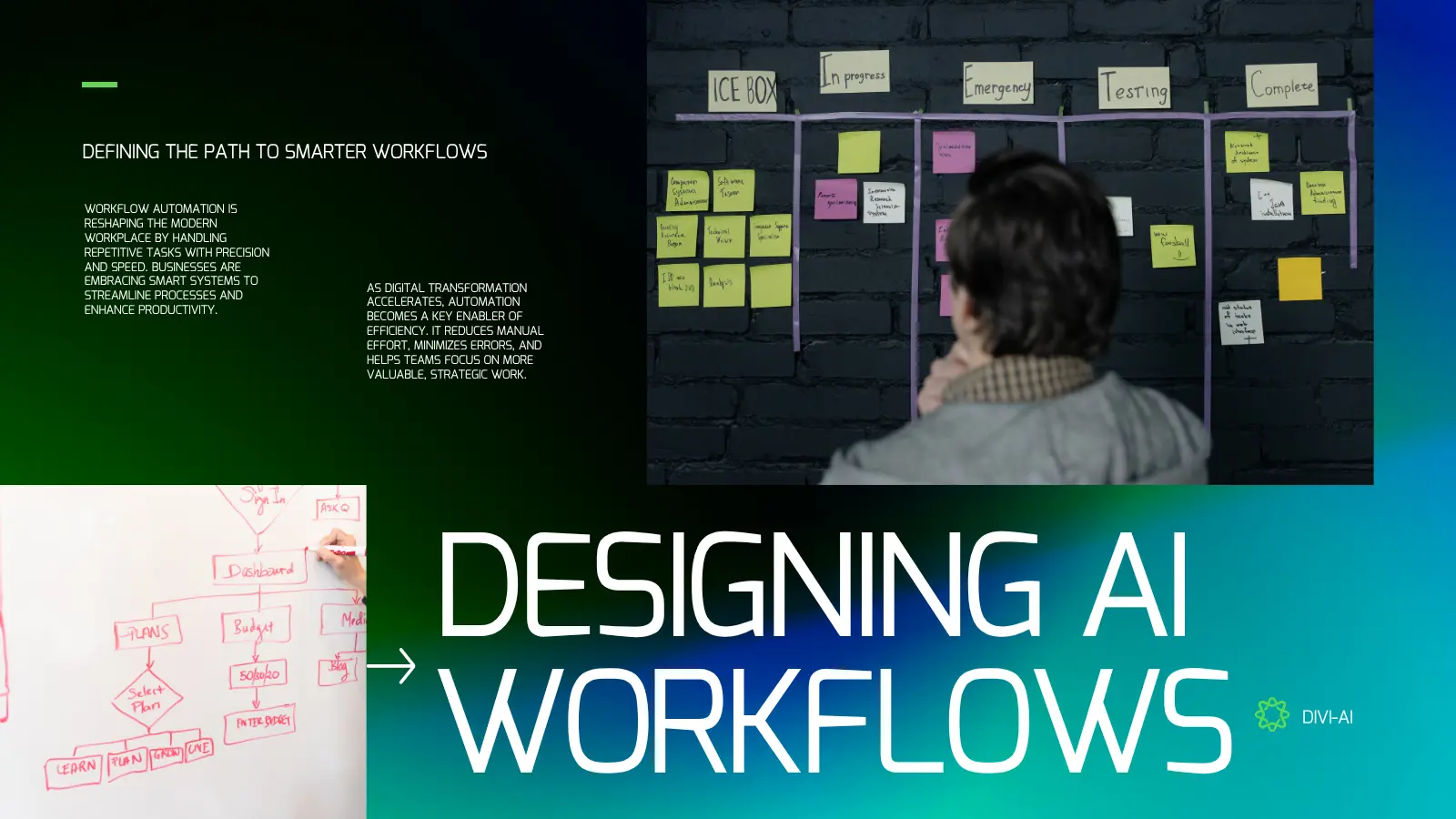
The Problem Is Not AI Adoption. It Is Workflow Design.
Most organizations are no longer questioning whether AI has value. The challenge today is designing AI into real operations without creating fragmented pilots or disconnected tools.
Many AI initiatives fail not because of technology, but because they begin with tools instead of workflows.
Real business impact comes from redesigning workflows around decisions, exceptions, accountability, and measurable outcomes.
For CXOs, AI automation is not an IT initiative—it is an operating model decision.
Start With the Business Constraint, Not the AI Tool
The first mistake in AI workflow design is asking where AI can be used.
The better question is where the business is constrained by manual interpretation, slow decisions, inconsistent execution, or high exception volume.
AI workflows are most valuable in areas where work depends on reading, interpreting, classifying, prioritizing, or recommending actions.
These include sales qualification, customer support triage, procurement evaluation, invoice validation, compliance checks, and internal approvals.
These are not just tasks—they are decision points embedded within operations.
Map the Workflow Before You Automate It
Effective AI workflows begin with clear process mapping.
Organizations must understand what triggers the workflow, what information is received, who reviews it, what decisions are made, and where delays or exceptions occur.
AI should be placed where interpretation or decision support creates measurable leverage—not randomly inserted into processes.
A well-designed workflow integrates AI, systems, and human review in a structured manner, ensuring both efficiency and control.
Separate Routine, Judgment-Based, and High-Risk Work
Not every part of a workflow should be automated equally.
Routine work includes repetitive tasks like data extraction, classification, summarization, and updates, which can be automated with minimal oversight.
Judgment-based work includes decisions where AI can recommend actions but humans should approve, such as vendor selection, credit evaluation, or sales prioritization.
High-risk work involves legal, financial, or compliance-sensitive decisions where AI should assist but not replace human authority.
This separation ensures both efficiency and risk control in AI-driven operations.
Design for Human-AI Collaboration, Not Full Autonomy
The goal of AI workflow design is not to eliminate people but to reposition them where they add the most value.
AI should handle interpretation, classification, and routine decisions, while humans focus on oversight, exceptions, and strategic judgment.
Workflows must clearly define what AI can do independently, what requires human approval, and what must be escalated.
This clarity is essential to ensure speed without compromising control.
Connect AI to Enterprise Systems
AI workflows create value only when they are integrated with business systems.
These include CRM, ERP, finance systems, document management, ticketing platforms, and data warehouses.
The workflow should not stop at recommendations—it should trigger real business actions such as updating records, routing approvals, or initiating transactions.
This is what transforms AI from a productivity tool into an operational capability.
Build Governance Into the Workflow From Day One
AI governance must be designed into workflows, not added later.
This includes role-based access, data permissions, approval levels, audit trails, and clear escalation rules.
AI systems often interact with sensitive business data, making governance essential for risk management.
Without governance, AI automation can create more risk than value.
Measure Business Outcomes, Not AI Activity
AI workflows should be evaluated based on operational outcomes, not technical metrics.
Key measures include reduction in turnaround time, decrease in manual effort, improved decision consistency, and increased throughput.
Organizations should establish baseline performance before implementation and track measurable improvements after deployment.
This ensures accountability and prevents AI from becoming a superficial technology initiative.
Start Narrow, Then Scale by Workflow Pattern
Successful AI programs begin with a focused workflow where value is clear and measurable.
Ideal starting points have high volume, repetitive decision patterns, and unstructured inputs.
Once a workflow is proven, the same pattern can be replicated across functions such as sales, support, procurement, and finance.
Scaling AI is not about deploying more tools—it is about replicating effective workflow designs.
Avoid the Common Failure Pattern
AI does not fix poorly designed processes.
If workflows are unclear, data is unreliable, or decision ownership is fragmented, AI will amplify these issues.
Before implementing AI, organizations must simplify and clarify processes, define decision rights, and ensure data quality.
AI workflow design is therefore also an exercise in operational discipline.
AI Workflow Design Is a Leadership Responsibility
AI workflows define how decisions move through an organization.
They enable faster operations, better consistency, reduced manual effort, and improved scalability.
However, the value is realized only when workflows are designed with clarity, governance, and measurable outcomes.
The organizations that succeed will not be those with the most AI tools, but those that redesign operations around intelligent workflows.
Next Step
Stay Updated
Request a consultation to design AI systems for your business.