
Build vs Buy vs Orchestrate: The Real AI Decision
Why enterprises must move beyond tools and start designing AI workflows.
The Illusion of Choice
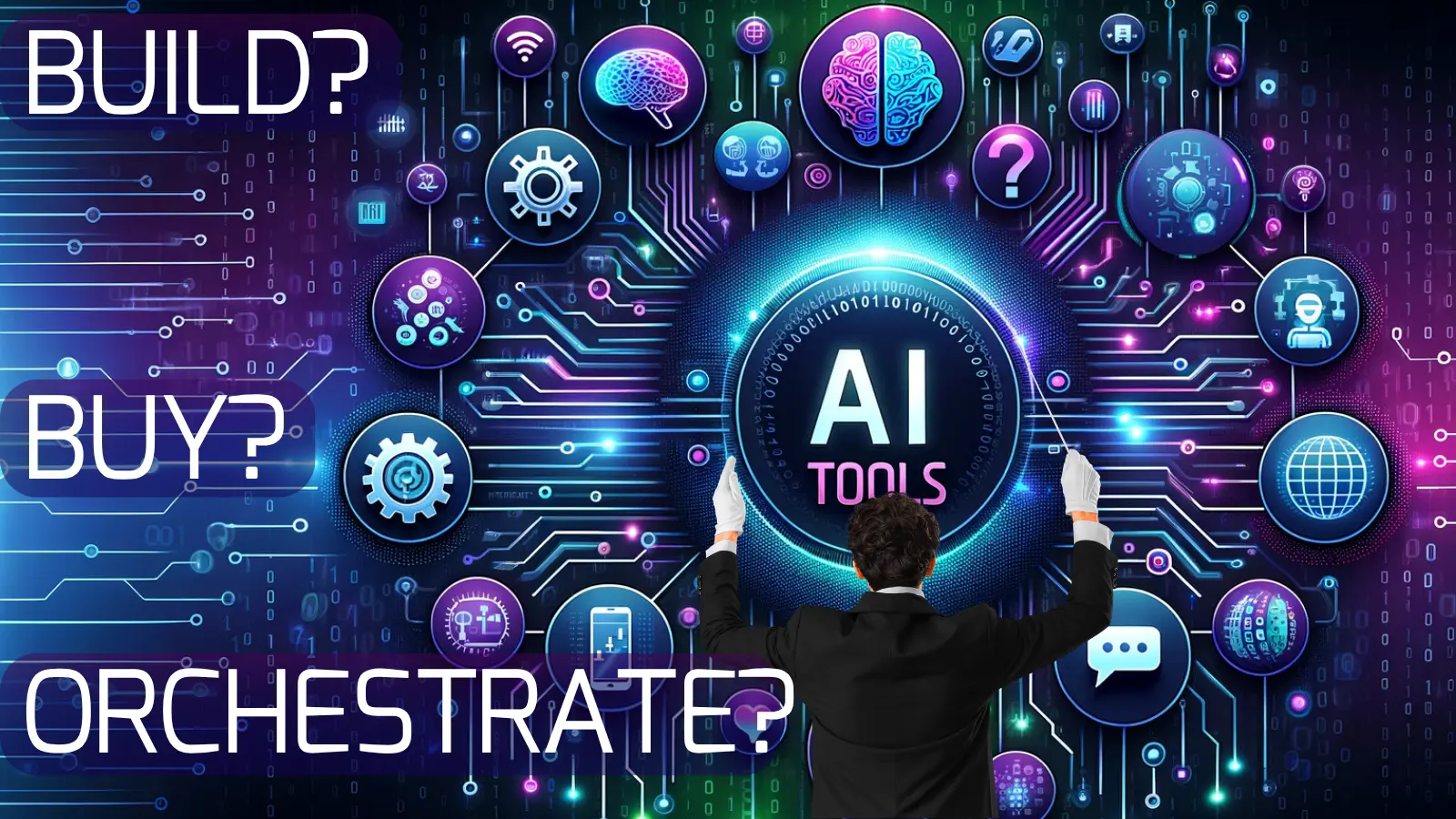
Every enterprise today is facing the same question: should we build AI systems, buy AI tools, or do something in between?
At first glance, the choices seem familiar. Build offers control, while buy offers speed.
But AI is not like traditional software. The explosion of SaaS tools, LLM APIs, and AI agents has created a fragmented landscape.
The result is not acceleration—it is complexity.
For CXOs, this is no longer a technical decision. It is an architecture and operating model decision.
Tool Proliferation Without System Design
Most organizations have already started adopting AI tools across functions—customer support, sales, operations, and analytics.
Individually, these tools deliver value. Collectively, they create fragmentation.
Each tool operates in isolation, with its own data, interface, and logic.
There is no shared workflow or unified decision-making layer.
The organization becomes a collection of tools rather than an integrated system.
Why the Traditional Build vs Buy Model Falls Short
Historically, enterprises evaluated technology decisions through a simple lens—build or buy.
Build offers control and customization but comes with high cost and long timelines.
Buy offers speed and ease of deployment but introduces limitations and vendor dependencies.
This framework worked for traditional software, but AI introduces a new dimension—decision flow across systems.
The problem is no longer just functionality, but how workflows operate end-to-end.
Why Buying AI Tools Is Not Enough
Buying AI tools solves point problems but does not solve workflow complexity.
Enterprise processes span multiple systems and require coordinated decision-making.
For example, a customer request may involve understanding intent, retrieving data, applying policies, and triggering actions across systems.
No single tool manages this end-to-end.
Without workflow integration, organizations create gaps between insight and execution.
When to Build
Building AI systems is justified when workflows are core to competitive advantage.
This includes areas such as pricing engines, risk models, and proprietary decision systems.
It is also relevant when deep integration with enterprise systems is required or when long-term control over data and logic is critical.
However, building everything is neither practical nor scalable for most organizations.
When to Buy
Buying AI tools is suitable for standardized capabilities and non-differentiating workflows.
This includes general productivity tools, basic automation, and common business functions.
It is also useful for rapid experimentation and short-term pilots.
However, beyond a certain point, adding more tools increases complexity instead of value.
The Missing Layer: Orchestration
Most enterprises today are not lacking tools—they are lacking connected workflows.
Orchestration is the layer that connects AI tools, enterprise systems, and business processes.
It defines how workflows operate end-to-end, how decisions are made, and how actions are triggered.
Instead of focusing on individual tools, orchestration focuses on how work actually gets done across the organization.
Where Divi-AI Fits: The Workflow Orchestration Layer
Divi-AI is designed as an orchestration layer that connects AI capabilities with real business workflows.
It allows organizations to design, execute, and manage workflows that span multiple systems and decision points.
Instead of replacing existing tools, it integrates them into a unified workflow layer.
This enables AI outputs to trigger actions, update systems, route decisions, and create measurable business outcomes.
The focus shifts from using AI tools to building AI-driven operational systems.
A Practical Decision Framework for CXOs
Enterprises should think of AI decisions across three layers.
The first layer is capabilities, where organizations choose whether to build or buy models, tools, and platforms.
The second layer is workflows, where orchestration defines how decisions flow across systems.
The third layer is governance, where approvals, controls, and accountability are managed.
Most organizations focus only on the first layer, while real value is created in the second.
The Strategic Risk of Ignoring Orchestration
Organizations that do not invest in orchestration face increasing complexity over time.
Tool sprawl, rising costs, fragmented workflows, and inconsistent decisions become structural challenges.
Without a workflow layer, scaling AI becomes difficult and inefficient.
Competitors that design integrated systems gain a significant advantage in speed, cost, and consistency.
From Tools to Systems
The AI decision is no longer about choosing between build or buy.
It is about designing systems that connect tools, data, and decisions.
Buying tools will continue, and building will remain important, but orchestration is what enables scale.
AI creates value not as a standalone tool, but as a system that connects workflows and actions.
The organizations that succeed will be those that design how everything works together.
Next Step
Stay Updated
Request a consultation to design AI workflows for your business.